

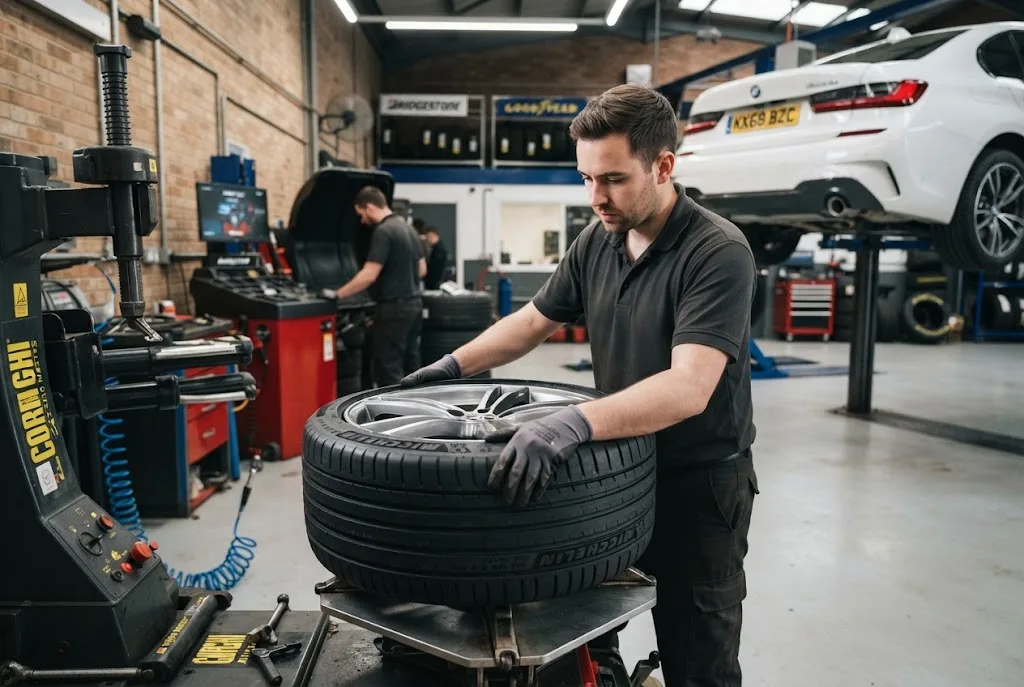
Tyre services cover much more than simply fitting a new set of tyres. For UK drivers, professional tyre fitting, tyre replacement, tyre repairs and tyre balancing all play an important role in keeping a vehicle roadworthy and predictable on the road. Understanding how these services work can also help motorists recognise when a tyre needs attention rather than waiting for a puncture, uneven wear or an MOT problem.
Tyres are the only parts of a car that maintain direct contact with the road, so their condition can affect braking, steering, grip, comfort and fuel efficiency. UK roadworthiness guidance requires car tyres to have at least 1.6mm of tread across the central three-quarters and around the entire circumference, while tyres must also be correctly inflated and free from certain defects. GOV.UK guidance on vehicle safety provides the official requirements drivers should understand.
Why Tyre Services Matter for UK Drivers
Regular tyre services can identify problems before they become more serious. A tyre may appear acceptable from a distance while having low pressure, uneven tread wear, sidewall damage or an embedded object that requires professional assessment.
TyreSafe recommends checking tyres at least once a month and before long journeys. These checks should cover pressure, tread depth and the overall condition of the tyre. Low pressure can affect handling and grip, while insufficient tread can reduce the tyre’s ability to move water away from the contact area. :contentReference[oaicite:0]{index=0}
Professional servicing becomes particularly useful when a driver notices vibration, steering changes, repeated pressure loss, uneven wear or visible damage. These symptoms can point to a tyre problem, but they can also indicate issues elsewhere in the wheel, suspension or steering system.
Tyre Fitting: More Than Removing and Installing a Tyre
Tyre fitting involves specialist equipment because a new tyre must be mounted correctly onto the wheel. The technician needs to use the appropriate tyre and wheel combination, inspect the components and ensure the finished assembly is suitable for the vehicle.
Correct fitting matters because an incorrectly installed tyre can create safety problems and potentially damage the tyre or rim. TyreSafe advises that tyre fitting and repair should be entrusted to trained specialists with the necessary equipment and expertise. It also recommends balancing wheels after tyres are fitted or replaced. :contentReference[oaicite:1]{index=1}
Drivers should therefore avoid treating tyre fitting as a simple cosmetic replacement. The correct size, specification, inflation pressure and installation procedure all contribute to the finished result.
What to Check After Tyre Fitting
After fitting, drivers should check that the tyres are inflated to the vehicle manufacturer’s recommended pressures. The correct pressure is normally available in the vehicle handbook or on information supplied by the manufacturer.
It is also sensible to pay attention to any new vibration, unusual noise or change in steering after installation. If something feels different, the vehicle should be inspected rather than assuming the sensation will disappear.
Tyre Replacement: When Is a New Tyre Necessary?
Tyre replacement is necessary when a tyre can no longer provide a safe and suitable service. Low tread, serious cuts, cracks, exposed cords, sidewall damage and certain forms of structural damage can make repair inappropriate.
The legal minimum tread depth for cars, light vans and light trailers in Great Britain is 1.6mm across the central three-quarters of the tyre and around the complete circumference. However, reaching the legal minimum should not be treated as a target for normal maintenance. Tyre condition, age, damage and wear patterns also need to be considered. :contentReference[oaicite:2]{index=2}
TyreSafe’s current guidance also highlights that replacement decisions depend on more than chronological age. There is no single universal service-life number that accurately predicts when every tyre must be removed from service. Manufacturers may provide specific recommendations, and drivers should consider the tyre’s condition and use. :contentReference[oaicite:3]{index=3}
This is why vehicle inspection can be useful when tyre condition forms part of a wider used-car assessment. A professional inspection can help identify whether apparent tyre wear is isolated or connected to alignment, suspension or other mechanical issues.
Tyre Repairs: When Can a Puncture Be Fixed?
Not every punctured tyre needs immediate replacement, but not every puncture can be safely repaired either. The decision depends on factors such as the location and size of the damage, the tyre’s overall condition and whether the tyre has suffered additional structural damage.
TyreSafe states that permanent car tyre repairs should be carried out by a tyre specialist in accordance with British Standard BS AU 159. Before a permanent repair, the tyre should be removed from the wheel so it can be inspected internally as well as externally. :contentReference[oaicite:4]{index=4}
A puncture in the central repairable area may sometimes be suitable for repair. Damage involving the sidewall, casing, bead, exposed cords, significant cracking or other serious deterioration may mean that replacement is the safer option.
Temporary puncture repair kits should not be confused with permanent tyre repairs. Modern vehicles may use sealant and compressor kits instead of spare wheels, but these are designed as temporary measures that allow the driver to reach a safe location or professional repair facility. :contentReference[oaicite:5]{index=5}
Why Slow Punctures Should Not Be Ignored
A slow puncture can be difficult to notice because pressure may fall gradually over days or weeks. Drivers may notice that one tyre needs topping up more frequently, the car pulls slightly to one side or the steering feels different.
These symptoms can also be caused by uneven wear, low pressure, wheel alignment or other vehicle problems. A professional assessment is therefore preferable to repeatedly adding air without finding the underlying cause.
Tyre Balancing and Why It Matters
Tyre balancing helps ensure the wheel and tyre assembly rotates smoothly. When a tyre is fitted or replaced, the wheel should be balanced using appropriate equipment so that weight distribution around the assembly is corrected.
Incorrect balance can contribute to vibration, particularly at higher speeds. Persistent steering-wheel vibration should not simply be accepted as a normal characteristic of the vehicle because it may indicate a balancing issue or another problem affecting the wheel, tyre, suspension or steering system.
Tyre balancing is therefore an important part of professional tyre services rather than an optional extra to consider only when a problem becomes severe. TyreSafe specifically advises that wheels should be balanced after tyres are fitted or replaced. :contentReference[oaicite:6]{index=6}
Understanding Tyre Lifespan
Tyre lifespan varies considerably between vehicles and drivers. Mileage alone cannot provide a reliable replacement date because tyres experience different loads, temperatures, road surfaces, pressures and driving conditions.
Driving style can influence wear, while incorrect inflation, wheel alignment problems and mechanical faults can cause tyres to wear unevenly. Storage conditions and prolonged periods of inactivity can also affect tyre condition.
For that reason, drivers should inspect tyres regularly instead of relying on a fixed mileage figure. TyreSafe notes that there is no technical basis for assigning one universal chronological service life to every tyre. Manufacturer recommendations should be followed where they exist, alongside regular checks of tread and physical condition. :contentReference[oaicite:7]{index=7}
Age can still matter. Certain commercial vehicles have specific UK restrictions concerning tyres aged 10 years or more, while manufacturers may recommend replacement periods for particular applications. Drivers should therefore check both the tyre markings and the manufacturer’s guidance rather than assuming that age is either always irrelevant or automatically decisive. :contentReference[oaicite:8]{index=8}
Tyre Safety Statistics: What the Data Shows
Official enforcement data demonstrates why tyre condition deserves attention. In the first quarter of the 2025–26 financial year, the Driver and Vehicle Standards Agency recorded “condition of tyres” as the leading prohibition defect category among cars inspected at roadside, accounting for 32.94% of all vehicles inspected in that dataset. :contentReference[oaicite:9]{index=9}
Tyres also feature prominently in other vehicle enforcement categories. For light goods vehicles inspected at roadside during the same quarter, tyre condition represented 21.47% of inspected vehicles in the top prohibition-defect dataset. For heavy goods vehicles inspected at roadside or operators’ premises, the corresponding figure was 7.97%. :contentReference[oaicite:10]{index=10}
These figures should be interpreted carefully. They are enforcement inspection statistics, not a measurement of the percentage of all UK vehicles with unsafe tyres. However, they clearly show that tyre condition is an important area of concern during professional vehicle inspections.
MOT data provides another useful perspective. The DVSA publishes aggregated MOT results and defect categories, allowing motorists and researchers to examine patterns in vehicle testing across Great Britain. :contentReference[oaicite:11]{index=11}
How to Get Better Value From Tyre Services
The cheapest immediate option is not always the best long-term choice. Drivers should compare the full cost of ownership, including tyre quality, expected use, fitting, balancing and the consequences of premature wear.
Maintaining correct tyre pressure is one of the simplest ways to support consistent tyre performance. Regular visual checks can also help identify damage before a minor problem becomes a replacement requirement.
It is equally important to distinguish between a genuine repair opportunity and a tyre that has reached the point where replacement is appropriate. Professional assessment can prevent drivers from spending money repeatedly on a tyre that should no longer be in service.
For motorists planning broader vehicle maintenance, understanding repair finance can also help when an unexpected tyre or mechanical bill arrives alongside other essential repairs. The key is to assess the total cost and avoid delaying safety-critical work simply because the expense was unexpected.
Tyre Services and the Wider Cost of Car Ownership
Tyres are only one part of the ongoing cost of owning a vehicle. Servicing, brakes, suspension, MOT testing, repairs, insurance and finance can all contribute to the annual ownership budget.
That makes preventive tyre care particularly valuable. Checking pressure, tread and condition regularly takes little time and can help drivers identify problems earlier. When replacement is necessary, choosing a suitable tyre and having it fitted and balanced correctly supports both safety and predictable vehicle performance.
Drivers researching vehicle ownership costs may also benefit from understanding car finance, particularly when deciding whether keeping an older vehicle is financially sensible compared with changing vehicles. Looking at the whole ownership picture is more useful than considering any single expense in isolation.
Simple Tyre Safety Routine for UK Drivers
A practical tyre routine does not need to be complicated. Check tyre pressure regularly using the vehicle manufacturer’s recommended settings, inspect the tread and look for cuts, bulges, cracks or embedded objects.
Before a long journey, give all four tyres and the spare or temporary repair equipment a closer inspection. If a tyre repeatedly loses pressure, develops unusual wear or produces vibration, arrange a professional assessment rather than continuing to drive without identifying the cause.
Finally, remember that an MOT certificate does not guarantee that a vehicle remains roadworthy between tests. GOV.UK makes clear that drivers are responsible for ensuring their vehicle is safe to drive at all times. :contentReference[oaicite:12]{index=12}
Final Thoughts on Tyre Services
Tyre services encompass a range of important maintenance tasks, from fitting and balancing to repairs and replacement. The right service depends on the condition of the tyre, the nature of any damage and the vehicle manufacturer’s requirements.
UK drivers can reduce avoidable risks by checking tyres regularly, responding promptly to pressure loss or visible damage and using qualified specialists for fitting and permanent repairs. The latest enforcement data also reinforces the importance of taking tyre condition seriously.
Good tyre maintenance is ultimately about more than passing an MOT. It is about keeping the vehicle’s contact with the road in a condition that supports safe, predictable driving throughout the year.
