Wheel alignment is an important part of vehicle maintenance because the position of a car’s wheels affects how the vehicle steers, handles and uses its tyres. When wheel angles move outside the manufacturer’s specified range, motorists may notice uneven tyre wear, a steering wheel that is not centred or a vehicle that tends to pull in one direction.
Alignment is different from wheel balancing, although both services are often offered by the same tyre and automotive workshops. Balancing addresses the distribution of weight around a wheel and tyre assembly, while alignment concerns the geometry of the wheels and suspension relative to the vehicle.
This guide explains key wheel alignment facts, including wheel tracking, steering alignment, alignment measurements, tyre wear, handling symptoms and when UK motorists should consider having their vehicle checked.
What Is Wheel Alignment?
Wheel alignment is the process of checking and, where adjustable, correcting the angles of the vehicle’s wheels so they correspond with the manufacturer’s specifications.
Modern alignment equipment measures the position and angle of the wheels and compares the results with specified values. Depending on the vehicle, technicians may assess several geometric measurements, including toe, camber and caster.
The purpose is not simply to make all four wheels point in exactly the same direction. Each vehicle is engineered with particular suspension and steering geometry, so the correct alignment depends on the manufacturer’s design.
Correct geometry helps the vehicle’s tyres maintain the intended relationship with the road while the steering and suspension operate as designed.
Wheel Alignment Measurements Explained
Several measurements can be used during an alignment check. The exact adjustment possibilities depend on the vehicle’s suspension design.
Toe
Toe describes the direction in which the tyres point when viewed from above. If the fronts of the tyres point slightly towards each other, this is generally referred to as toe-in. If they point away from each other, it is toe-out.
Incorrect toe can contribute to abnormal tyre wear and can affect the vehicle’s straight-line behaviour.
Camber
Camber describes the inward or outward tilt of a wheel when viewed from the front of the vehicle. A wheel leaning inward at the top has negative camber, while one leaning outward has positive camber.
Camber is part of the suspension geometry and can influence how the tyre contacts the road during cornering and normal driving.
Caster
Caster relates to the steering axis when viewed from the side of the vehicle. It contributes to steering feel, stability and the steering system’s tendency to return towards its normal position after a turn.
Not every vehicle allows all alignment angles to be adjusted directly. In some cases, a measurement outside specification may indicate worn or damaged suspension or steering components rather than a simple adjustment issue.
Wheel Tracking and Wheel Alignment
Wheel tracking is a term commonly used by UK garages and tyre centres when referring to alignment, particularly front-wheel alignment. However, the terminology can vary between businesses.
A basic tracking adjustment may concentrate on toe settings, while a full four-wheel alignment can assess the geometry of both axles and their relationship to the vehicle’s centreline.
This distinction matters because correcting the front wheels alone may not address an alignment problem originating from the rear axle. A technician should determine what measurements are appropriate for the particular vehicle rather than assuming that every alignment service involves exactly the same procedure.
How Wheel Alignment Affects Tyre Wear
One of the most visible consequences of poor alignment can be abnormal tyre wear. When wheel geometry is incorrect, a tyre may not contact the road surface in the way intended by the vehicle manufacturer.
The UK Highway Code’s vehicle maintenance guidance states that excessive or uneven tyre wear can be caused by faults in braking or suspension systems or by wheels being out of alignment. It advises that such faults should be corrected as soon as possible. GOV.UK vehicle maintenance guidance
Uneven wear can appear in different ways. A tyre may show greater wear on one shoulder, or the tread can develop a pattern associated with incorrect geometry or suspension condition.
However, alignment is not the only possible cause. Incorrect tyre pressures, worn suspension components, braking faults, road impacts and normal wear can also affect tyre condition. A proper inspection is therefore more useful than assuming alignment is responsible for every uneven-wear pattern.
Signs Your Car May Need an Alignment Check
Drivers may notice several symptoms when wheel geometry is outside the intended range. These can include:
- The vehicle pulling noticeably to one side.
- An off-centre steering wheel when travelling straight.
- Uneven or unusually rapid tyre wear.
- The vehicle feeling less stable than expected.
- Steering behaviour that seems different after hitting a pothole or kerb.
- Visible differences in tyre wear between the inner and outer edges.
These symptoms are not proof of an alignment fault. Steering, suspension, tyre pressure, tyre condition and braking problems can create similar sensations.
For example, GOV.UK advises that if a vehicle pulls to one side when braking, the likely causes can include a brake fault or incorrectly inflated tyres. Highway Code vehicle safety guidance
Potholes Can Affect Wheel Alignment
UK roads can expose vehicles to potholes, uneven surfaces and kerb impacts. A significant impact can potentially affect a wheel, tyre, steering component or suspension part.
If a driver notices a new steering problem after hitting a pothole, it is sensible to have the vehicle inspected rather than assuming that an alignment adjustment alone will solve the issue.
A damaged suspension or steering component may need to be repaired before accurate alignment can be achieved. Aligning a vehicle without addressing a worn or bent component may provide only a temporary solution or make it impossible to achieve the manufacturer’s specified geometry.
Wheel Balancing vs Wheel Alignment
Wheel balancing and alignment are often confused because both are performed in tyre and automotive workshops, but they address different problems.
Balancing concerns the distribution of weight around the wheel and tyre assembly. If the assembly is unbalanced, the driver may experience vibration, particularly at certain speeds.
Alignment concerns wheel geometry. A vehicle with an alignment problem may show uneven tyre wear, steering symptoms or directional instability without experiencing the vibration normally associated with an imbalance.
It is possible for a vehicle to need both services at different times. For example, fitting a new tyre may require the wheel and tyre assembly to be balanced, while a pothole impact may justify an alignment inspection.
Why Correct Tyre Pressure Matters
Tyre pressure should be checked before assuming that a vehicle needs alignment work. Incorrect pressure can change how the vehicle handles and can contribute to uneven tyre wear.
The Highway Code advises drivers to check tyre pressures weekly, when the tyres are cold, and to follow the vehicle manufacturer’s specified pressures. It also warns that under-inflated or over-inflated tyres can adversely affect braking and steering. GOV.UK tyre pressure guidance
This is why a good workshop should consider the overall condition of the tyres and vehicle rather than treating alignment as an isolated measurement.
Does Every Car Need Four-Wheel Alignment?
Not every alignment service is identical. Whether a technician checks or adjusts two wheels or all four depends on the vehicle and the nature of the problem.
Vehicles with independent rear suspension may have adjustable rear alignment angles, while other designs have more limited adjustment. A full four-wheel alignment can nevertheless be useful when the equipment and vehicle specifications support it because the technician can evaluate the relationship between the front and rear axles.
The correct procedure should be determined by the manufacturer’s specifications and the vehicle’s suspension design.
How Alignment Equipment Works
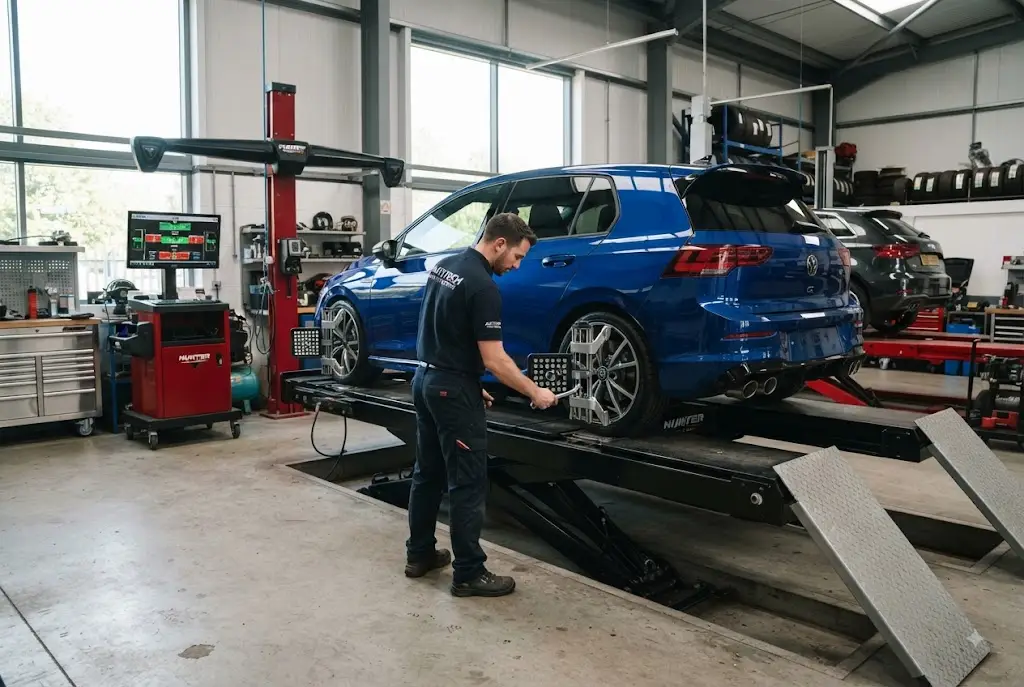
Modern alignment systems use sensors or targets attached to the wheels to measure their positions relative to each other and the vehicle.
The equipment can generate measurements that show whether individual angles fall within specified ranges. Technicians can then make appropriate adjustments where the vehicle design allows them.
Advanced alignment systems may provide detailed readings for individual wheels, axle relationships and steering geometry. The quality of the final result depends not only on the equipment but also on correct setup, accurate vehicle specifications and the technician’s assessment of the vehicle’s mechanical condition.
Wheel Alignment and Vehicle Handling
Correct geometry contributes to predictable steering and handling. When wheel angles are outside their intended range, the vehicle may not respond exactly as designed.
Drivers may notice that the steering wheel is not centred, the vehicle requires more correction to travel straight or the car behaves differently during cornering.
However, handling is influenced by many other factors, including tyre condition, pressure, suspension wear, steering components and road surface. Alignment should therefore be considered one part of the overall vehicle dynamics rather than the sole determinant of handling.
Wheel Alignment After New Tyres
Fitting new tyres does not automatically mean that a vehicle needs alignment. However, new tyres provide an opportunity to inspect the existing tread pattern and identify signs of abnormal wear.
If the old tyres show significant uneven wear, checking alignment and suspension condition can help identify an underlying problem before the new tyres are subjected to the same issue.
Correct wheel geometry is also relevant to getting the intended performance and service life from replacement tyres.
Wheel Alignment and Vehicle Safety
Tyres and steering systems are directly connected to road safety. GOV.UK states that motorists are responsible for ensuring their vehicles remain roadworthy, even when they have a current MOT certificate. GOV.UK vehicle safety checks
The current MOT inspection manual also contains detailed requirements for axles, wheels, tyres and suspension, including tyre tread, wheel condition and suspension components. GOV.UK MOT inspection manual
An alignment check is not itself a substitute for an MOT or a complete safety inspection. Instead, it is a specialist measurement that can help identify geometry issues affecting tyres, steering and vehicle behaviour.
How Often Should Wheel Alignment Be Checked?
There is no universal mileage interval that requires every UK vehicle to receive a wheel alignment. The need depends on the vehicle, driving conditions, suspension condition and any symptoms that develop.
A check can be sensible after a significant pothole or kerb impact, when unusual tyre wear appears, after suspension or steering repairs, or when the vehicle develops a persistent pulling or steering-centre issue.
Drivers should also follow the manufacturer’s maintenance recommendations and have suspected steering or suspension problems investigated promptly.
Wheel Alignment for Electric and Hybrid Vehicles
Alignment principles also apply to electrified vehicles. Electric and hybrid cars still rely on tyres, steering and suspension to maintain contact with the road.
Vehicle weight distribution, tyre specifications and suspension design can differ between models, so technicians should use the correct manufacturer data when checking alignment.
This connects wheel alignment with the wider changes taking place in the UK automotive aftermarket. Our guides to hybrid servicing and EV servicing explain how workshops are adapting to increasingly electrified vehicles.
Wheel Alignment and the UK Automotive Service Market
Alignment is one of many specialist services provided by automotive service companies across the UK. It can be offered by independent garages, tyre centres, national garage chains and specialist workshops.
The availability of modern alignment equipment means many workshops can provide detailed measurements rather than relying solely on visual inspection. Nevertheless, equipment readings still need to be interpreted alongside the physical condition of the vehicle.
This is particularly important where worn bushes, damaged suspension arms, steering components or wheel damage could be responsible for abnormal readings.
Final Thoughts
Wheel alignment is an important vehicle maintenance service that focuses on steering and suspension geometry rather than wheel balance. Correct alignment can help support predictable handling and reduce the risk of abnormal tyre wear, while incorrect geometry may contribute to steering and tyre problems.
Wheel tracking is often used as a general term for alignment work, but motorists should ask what measurements and adjustments are included. A full assessment may involve toe, camber and caster measurements depending on the vehicle’s design.
Drivers should also remember that uneven tyre wear or pulling to one side can have several causes. Tyre pressures, brakes, suspension, steering components and wheel damage should all be considered before assuming alignment is the only issue.
For UK motorists, the best approach is simple: maintain correct tyre pressures, inspect tyres regularly, respond to changes in steering or handling and have the vehicle professionally checked when alignment problems are suspected. These habits can support safer driving and help identify developing vehicle faults before they become more serious.