EV servicing is becoming an increasingly important part of the UK’s automotive aftermarket as more drivers move from petrol and diesel vehicles to battery electric cars. Although electric vehicles have fewer conventional mechanical components, they still require regular inspections, maintenance and specialist checks to remain safe, efficient and reliable.
The biggest difference is the powertrain. Instead of an internal combustion engine, a battery electric vehicle uses a high-voltage battery, electric motor, power electronics and associated control systems. That changes the type of work technicians perform and creates a growing need for properly trained EV mechanics.
This guide explains the key facts about EV servicing, including electric vehicle maintenance, battery servicing, charging equipment, battery lifespan, MOT requirements, technician skills and the changing UK EV market.
What Does EV Servicing Include?
EV servicing does not mean simply checking the battery. An electric vehicle still contains tyres, brakes, suspension, steering, lights, air conditioning equipment, safety systems and many other components that require inspection.
Depending on the manufacturer and vehicle, an EV service may include checks of:
- High-voltage electrical systems.
- Traction battery condition.
- Electric motor and power electronics.
- Charging equipment and connections.
- Regenerative braking systems.
- Conventional braking components.
- Tyres and suspension.
- Steering and wheel components.
- Cabin filters and relevant fluids.
- Software and diagnostic systems.
The exact maintenance schedule varies by manufacturer and model. Owners should therefore use the vehicle handbook or manufacturer’s service programme rather than assuming every EV has the same servicing interval.
Why EV Servicing Is Different From Petrol and Diesel Maintenance
Electric vehicles generally have fewer moving powertrain components than internal combustion vehicles. There is no conventional engine oil, exhaust system, spark plugs or multi-component combustion engine requiring the same type of maintenance.
This can reduce some routine maintenance requirements. However, EVs introduce high-voltage electrical systems that require specific knowledge and safety procedures.
The Driver and Vehicle Standards Agency’s current MOT inspection guidance specifically warns that propulsion batteries in electric and hybrid vehicles can carry high voltage and that additional care is required when inspecting them. :contentReference[oaicite:0]{index=0}
As a result, EV maintenance is not necessarily simpler in every respect. It is different, with greater emphasis on electrical systems, diagnostics, battery condition and high-voltage safety.
EV Mechanics Need Specialist Skills
The growth of electric vehicles is creating new requirements for EV mechanics. Technicians working on high-voltage systems need appropriate training and equipment for the vehicles they service.
High-voltage components can include the traction battery, inverter, high-voltage cables, electric motor and associated control equipment. These systems should not be treated like ordinary 12-volt vehicle electrical circuits.
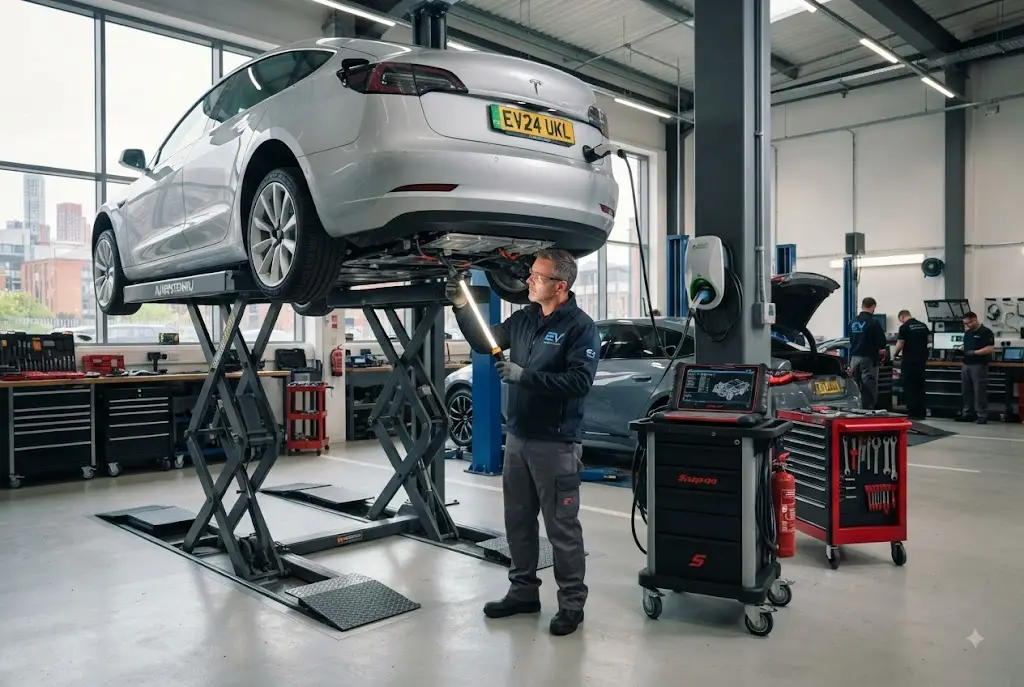
Professional workshops may need specialist diagnostic equipment, insulated tools, personal protective equipment and procedures for isolating high-voltage systems before certain repairs are undertaken.
This does not mean every technician needs to work directly on a traction battery. Many routine jobs, such as tyre replacement or some suspension work, may not involve opening or repairing the high-voltage system. Nevertheless, technicians need to understand the vehicle’s electrical architecture and relevant safety requirements.
Electric Vehicle Maintenance Still Covers Brakes and Tyres
One misconception about electric vehicle maintenance is that EVs require very little mechanical attention. While the electric powertrain has fewer moving parts, the vehicle still travels on four tyres and uses mechanical braking and suspension systems.
Tyre condition is particularly important because many EVs are relatively heavy and can deliver strong instant torque. Correct tyre pressure, suitable tread and regular inspection remain essential.
Brakes also require attention. Regenerative braking can recover energy when the vehicle slows down and can reduce reliance on friction brakes in some driving conditions. However, brake discs, pads and other components still need inspection.
For motorists, this means routine checks should continue even when an EV does not have the same engine-related maintenance requirements as a petrol or diesel car.
EV Battery Servicing Is About More Than Replacement
EV battery servicing is often misunderstood as replacing the entire battery pack. In reality, battery-related maintenance can involve inspection, diagnostics, software checks, cooling systems, electrical connections and assessment of battery health.
Modern EV batteries contain multiple cells and electronic management systems. The battery management system monitors factors such as temperature, voltage and charging behaviour to help manage the pack.
When a battery-related problem occurs, a qualified technician may first need to determine whether the issue concerns an individual component, a battery-management system, cooling equipment, charging hardware or the battery pack itself.
Full battery replacement is therefore only one possible outcome of a battery fault and should not be assumed whenever an EV develops a problem.
How Long Do EV Batteries Last?
Battery lifespan is one of the most important questions for EV owners and used-car buyers. However, there is no single mileage or number of years that applies to every electric vehicle battery.
Battery degradation depends on factors such as battery chemistry, thermal management, charging behaviour, climate, vehicle use and the manufacturer’s design.
UK government guidance for vehicles eligible for the Electric Car Grant defines a reasonable degradation benchmark for battery electric vehicles as retaining at least 80% of initial or rated capacity for the first three years, or 70% for the first eight years, depending on the evidence route used for eligibility. This is a regulatory benchmark rather than a universal prediction of how long an individual EV battery will last. :contentReference[oaicite:1]{index=1}
More recent real-world research also provides encouraging evidence. A 2026 study of 8,000 electric cars reported by the RAC found an average battery state of health of 95% across its sample, including vehicles up to 12 years old. :contentReference[oaicite:2]{index=2}
These findings show why battery health should be assessed using evidence from the particular vehicle rather than relying on assumptions about EV batteries.
Charging Infrastructure Can Affect EV Ownership
Charging is not technically the same thing as servicing, but it is an important part of electric vehicle ownership. EV drivers can charge at home, at workplaces and at public charging locations depending on their circumstances.
Different charging systems can provide different power levels. Home charging is commonly used for routine overnight charging, while higher-powered public chargers can be useful during longer journeys.
The vehicle’s onboard charging system and battery management software determine how electrical energy is accepted by the car. The charging equipment, cable and electrical installation also need to be appropriate for the intended use.
For servicing professionals, charging-related diagnostics can become increasingly relevant because faults may originate from the vehicle, charging connection, onboard charger or associated electrical systems.
Does an EV Need an Annual Service?
There is no single UK-wide servicing interval that applies to every electric car. Manufacturers establish their own maintenance schedules, and these can differ significantly between models.
The RAC notes that many manufacturers recommend electric car servicing at intervals around 12 months or 10,000 to 20,000 miles, whichever comes first, but advises owners to check the individual vehicle handbook because service intervals vary. :contentReference[oaicite:3]{index=3}
Some EVs may use condition-based monitoring or longer service intervals, while others require scheduled inspections. Owners should follow the manufacturer’s instructions even if the car appears to require less maintenance than a conventional vehicle.
EV Servicing and the UK MOT
Electric vehicles still require an MOT when they reach the applicable age threshold in Great Britain. The GOV.UK guidance states that most vehicles need their first MOT by the third anniversary of registration and subsequently every year. Different processes apply in Northern Ireland. :contentReference[oaicite:4]{index=4}
An MOT should not be confused with scheduled servicing. The MOT assesses whether the vehicle meets relevant road safety and environmental standards at the time of testing, whereas servicing follows a manufacturer’s maintenance programme.
The current MOT inspection manual includes specific provisions for electric and hybrid vehicles. Its battery guidance states that propulsion batteries should generally be assessed visually and warns testers about the risks associated with high-voltage components and cabling. :contentReference[oaicite:5]{index=5}
EV Maintenance Can Reduce Some Routine Costs
One potential advantage of electric vehicles is that their powertrains contain fewer moving parts than conventional combustion drivetrains. This can reduce the number of components that require routine servicing.
The RAC has previously cited research suggesting that EV service and maintenance costs can be lower than those of petrol and diesel vehicles over a typical ownership period. However, actual costs vary according to the vehicle, mileage, tyres, brakes, service schedule, repair requirements and labour rates. :contentReference[oaicite:6]{index=6}
EV owners should therefore avoid assuming that servicing will always be cheaper. A vehicle can have lower routine maintenance requirements while still incurring significant costs for tyres, bodywork, suspension, electronics or specialist repairs.
Software Is Becoming Part of Vehicle Maintenance
Modern EVs rely heavily on software. Vehicle control systems manage charging, battery operation, thermal management, driver assistance functions and other features.
Software updates can therefore become part of the ownership experience. Some updates may be performed remotely, while others may require workshop equipment or manufacturer involvement.
For EV mechanics, this means diagnostic ability is becoming increasingly important. Understanding fault codes and physical components is only part of the job; technicians may also need to interpret electronic data and manufacturer-specific diagnostic information.
EV Servicing and Battery Cooling Systems
Temperature management is important for lithium-ion battery systems. EV manufacturers use different thermal management designs to keep batteries within appropriate operating conditions.
Depending on the vehicle, thermal management can involve liquid cooling, refrigerant-based systems or other engineering approaches. Problems with cooling can affect battery performance and may trigger warnings or protective measures.
During appropriate servicing procedures, technicians may therefore need to inspect relevant cooling components and follow manufacturer instructions for the particular vehicle.
EV Adoption Is Changing the Automotive Aftermarket
Growing EV adoption is gradually changing the composition of the UK vehicle fleet. The Department for Transport and DVLA maintain regularly updated vehicle statistics covering new registrations and licensed vehicles, including zero-emission vehicles. :contentReference[oaicite:7]{index=7}
This transition creates a long-term opportunity for workshops that develop EV capabilities. Garages that once focused primarily on conventional engines and transmissions increasingly need to understand high-voltage systems, battery diagnostics, charging faults and electric drivetrains.
The change does not mean conventional mechanical skills will become irrelevant overnight. Petrol, diesel, hybrid and electric vehicles will coexist on UK roads for many years, meaning workshops may need to support multiple technologies simultaneously.
Choosing a Garage for EV Servicing
EV owners should consider whether a garage has the appropriate skills and equipment for their particular vehicle before booking specialist work.
Useful questions include:
- Does the garage have technicians trained to work on EVs?
- Can it perform the manufacturer’s recommended service?
- Does it have suitable high-voltage safety equipment?
- Can it diagnose EV battery and charging faults?
- Does it have appropriate manufacturer-level or compatible diagnostic equipment?
- Can it provide a clear explanation of the work required?
For routine services, an experienced independent workshop may be suitable. For complex battery or high-voltage repairs, owners may prefer a specialist EV facility or manufacturer-authorised service centre with the required capabilities.
EV Servicing and Wheel Alignment
Not every important EV maintenance task involves the electrical system. Wheel and tyre condition remain fundamental to safe and efficient driving.
Incorrect wheel geometry can contribute to uneven tyre wear and affect handling. Because tyres are also a major interface between an EV and the road, maintaining correct alignment and condition remains important.
Our related guide to wheel alignment facts explains how alignment measurements, tracking and tyre wear relate to vehicle handling.
EV Servicing and the Future of Garage Networks
The growth of electric vehicles is likely to influence the wider network of UK garage chains and independent workshops. Businesses that invest in training and equipment can expand the range of vehicles they are able to service.
At the same time, workshops need to manage the transition carefully. EV technology requires different safety procedures, diagnostic capabilities and technical knowledge, while the existing petrol and diesel fleet still creates substantial demand for traditional servicing.
The result is likely to be a mixed aftermarket in which technicians increasingly work across several propulsion technologies.
Final Thoughts
EV servicing is different from traditional car maintenance, but electric vehicles still require regular professional attention. High-voltage systems, battery health, charging equipment, brakes, tyres, suspension, software and other vehicle systems all contribute to safe and reliable operation.
Battery technology is also proving more durable than some early expectations suggested. Recent real-world research has found strong battery health among a large sample of older EVs, while UK government policy now includes explicit battery degradation requirements for certain vehicle incentives.
For owners, the most important approach is straightforward: follow the manufacturer’s service schedule, monitor the vehicle for warning signs and use appropriately trained professionals for specialist work. As EV adoption continues, these practices will become an increasingly normal part of UK vehicle ownership.