A mobile auto service brings vehicle maintenance or repair to the customer’s location rather than requiring the car to be taken to a traditional workshop. For many UK motorists, that can mean greater convenience when a vehicle will not start, a routine repair is needed at home, or finding time for a workshop visit is difficult.
Mobile mechanics have become an increasingly visible part of the automotive service landscape. Their work can range from routine maintenance and diagnostics to roadside assistance and selected repairs. However, mobile servicing is not a replacement for every type of workshop repair. Understanding what these services can realistically provide makes it easier to choose the right option.
What Is Mobile Auto Service?
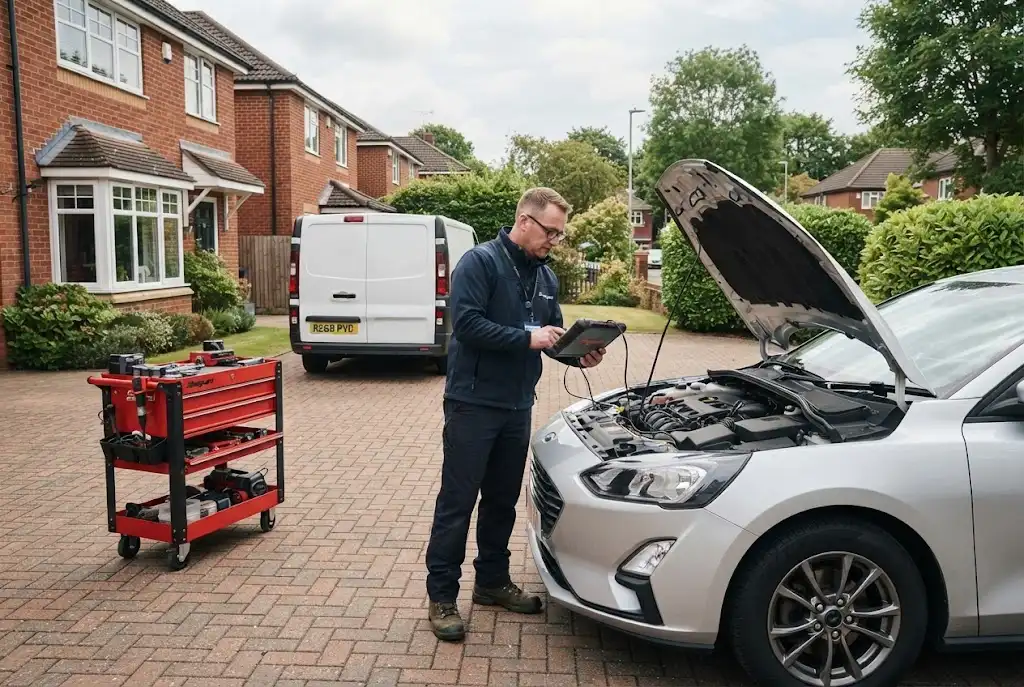
Mobile auto service refers to automotive maintenance, inspection, diagnostics or repair carried out at a location convenient to the vehicle owner. Instead of driving to a garage, a technician travels to the customer.
The location might be a home driveway, workplace car park or, where appropriate, a roadside location. The precise services available depend on the technician, equipment, vehicle and nature of the fault.
This model is particularly useful when the vehicle can no longer be driven safely. In other situations, it simply saves the owner a journey and reduces the disruption associated with leaving a vehicle at a workshop.
How Mobile Mechanics Work
A mobile mechanic usually begins by discussing the vehicle’s symptoms and the work required. This initial information helps determine whether the job is suitable for a mobile visit.
The technician then arrives with tools and equipment appropriate to the expected task. For suitable repairs, the work can often be completed at the customer’s location. Diagnostic equipment may also be used when an electronic fault or dashboard warning needs further investigation.
Not every repair can be performed outside a workshop. Jobs requiring specialist machinery, extensive dismantling, controlled workshop conditions or particular lifting equipment may need to be transferred to a garage.
That distinction is important because mobile servicing works best when the service matches the technical requirements of the job.
Why Roadside Servicing Can Be Useful
Roadside servicing is one of the most practical applications of mobile automotive support. A breakdown can leave a driver facing an immediate problem, particularly when the vehicle is parked away from home.
Depending on the fault, a mobile technician may be able to diagnose the problem and carry out a suitable repair without requiring the vehicle to be transported to a workshop.
However, safety should always come first. A roadside location may not be suitable for extensive mechanical work, especially on a busy road or in poor weather. If the vehicle or its surroundings create a danger, recovery to a safer location may be the better option.
Drivers should also remember that professional roadside assistance is different from attempting a complex repair themselves. A qualified technician can assess whether the vehicle can be safely repaired where it stands.
Mobile Servicing Facts Drivers Should Know
One of the most useful mobile servicing facts is that convenience does not necessarily mean limited technical capability. Modern mobile technicians can carry diagnostic equipment, specialist tools and replacement parts needed for many common jobs.
At the same time, the mobile model has practical limitations. A technician has less space and equipment than a fully equipped workshop, and some jobs require facilities that cannot reasonably be transported to a driveway or roadside location.
Therefore, the right question is not simply whether a mechanic is mobile. It is whether the specific repair or inspection is appropriate for mobile work.
For more information about the wider inspection side of vehicle maintenance, see our guide to auto inspection services.
Mobile Repair Statistics and Industry Growth
Interest in mobile repair statistics often reflects a wider question about how vehicle servicing is changing. However, statistics for the mobile mechanic segment are not always directly comparable because different studies may define mobile repair, roadside assistance and automotive servicing differently.
For that reason, broad claims about industry growth should be treated carefully. A rise in mobile repair businesses does not automatically prove that every type of vehicle repair is moving away from conventional workshops.
Instead, the growth of mobile services can be understood as part of a broader shift towards convenience-based services. Consumers increasingly expect services to fit around their schedules, and vehicle maintenance is no exception.
The development of vehicle diagnostics has also helped mobile technicians handle problems that once required a workshop visit simply to identify the fault.
Service Availability Across the UK
Service availability varies considerably by location. Large towns and cities may have several mobile mechanics serving residential areas, business districts and surrounding communities. Rural areas may have fewer providers, although mobile servicing can be particularly valuable where the nearest workshop is a significant distance away.
Availability can also depend on the type of vehicle and repair required. A technician specialising in a particular manufacturer or diagnostic system may not cover every location or every vehicle.
Before booking, drivers should check the service area, qualifications or experience offered, the type of work covered and whether any parts or additional workshop work could be required.
For owners comparing different maintenance approaches, our guide to auto care services provides useful context on broader vehicle maintenance.
Mobile Auto Service vs Traditional Garage
Both mobile mechanics and traditional garages have advantages. A mobile service can reduce travel, minimise disruption and provide convenient assistance at home or another suitable location.
A garage, on the other hand, has access to a permanent workspace and a wider range of equipment. This can make it more appropriate for major mechanical repairs, extensive diagnostics or work that requires specialist machinery.
The best choice depends on the problem rather than on the service model alone.
When Mobile Service Makes Sense
- Routine maintenance that can safely be completed at the customer’s location.
- Selected diagnostic investigations.
- Minor repairs and component replacement.
- Vehicle problems that prevent normal travel to a garage.
- Convenient servicing at a home or workplace.
When a Workshop May Be Better
- Major engine or transmission repairs.
- Jobs requiring extensive dismantling.
- Repairs needing specialist workshop machinery.
- Work that cannot safely be performed at the vehicle’s location.
- Problems requiring prolonged investigation in a controlled environment.
How Mobile Servicing Fits Into Vehicle Maintenance
Mobile servicing should be considered part of a broader maintenance strategy rather than a separate alternative to vehicle care. Drivers still need to follow appropriate manufacturer recommendations and pay attention to warning signs.
Regular checks can identify issues before they develop into larger problems. Professional inspections can then provide a more detailed assessment when something appears unusual.
Keeping accurate service records is equally important. Documentation can help owners understand what work has already been completed and what may be due next. It can also become useful when calculating the overall car service cost of owning a vehicle.
For a longer-term view, drivers can combine mobile servicing with a planned vehicle servicing timeline. This approach makes it easier to distinguish between routine maintenance, unexpected repairs and scheduled service milestones.
Technology Is Changing Mobile Mechanics
Modern vehicles rely heavily on electronic systems, sensors and computer-controlled components. As a result, diagnostic technology has become an important part of automotive servicing.
Portable diagnostic equipment allows technicians to investigate many electronic faults without having the vehicle inside a conventional workshop. This does not eliminate the need for physical inspections, but it can speed up the process of identifying where further investigation is required.
The combination of portable tools, diagnostic equipment and increasingly capable service vehicles has helped make mobile automotive work more practical for a wider range of problems.
What to Check Before Booking a Mobile Mechanic
Before arranging a mobile visit, provide as much useful information as possible. Tell the technician the vehicle make and model, symptoms, dashboard warnings and any recent repairs.
It is also worth asking what the quoted service includes. A diagnostic visit, for example, may identify a fault without including the cost of replacement parts or subsequent repair work.
Drivers should also confirm whether the technician can legally and safely work at the proposed location. A driveway may be suitable for one job but unsuitable for another.
The Future of Mobile Auto Service
The appeal of mobile auto service is closely connected to convenience. As motorists look for ways to reduce disruption and manage vehicle ownership around work and family commitments, services that come to the customer can remain attractive.
However, the future is unlikely to mean that traditional garages disappear. Instead, mobile mechanics and workshops can serve different needs within the same automotive ecosystem.
Mobile services are well suited to convenient maintenance, diagnostics and selected repairs, while workshops remain essential for jobs requiring specialist equipment, extensive repairs and controlled working environments.
Final Thoughts on Mobile Mechanics
Mobile mechanics offer a practical way to maintain and repair suitable vehicles without every job requiring a trip to a garage. Their value is particularly clear when convenience, location or vehicle immobility makes traditional servicing difficult.
At the same time, motorists should look beyond simple claims about industry growth or mobile repair statistics. The most important consideration is whether the technician has the right expertise, equipment and working environment for the particular job.
Used alongside regular vehicle checks, professional inspections and a structured maintenance plan, mobile auto service can become a useful part of modern vehicle ownership. Understanding its strengths and limitations allows drivers to choose the most appropriate solution when maintenance or repairs are needed.
To continue exploring the topic, read our related guides on vehicle inspections, auto care services, servicing costs and the vehicle servicing timeline.
For official UK information on vehicle safety, MOT requirements and responsibilities, drivers can consult the GOV.UK MOT guidance.